By Paula Grisanti, National Stem Cell Foundation
An investigational therapy developed from tumor organoids grown in orbit has already advanced to early clinical trials. A protein-based artificial retina — manufactured in microgravity — is on track for first-in-human testing in 2028. A cartilage repair scaffold built in space bound ten times more stem cells than anything produced on the ground. Cleveland Clinic, Cedars-Sinai, and the University of Pittsburgh have all launched dedicated space medicine programs, each translating discoveries on the International Space Station (ISS) into treatments for patients on Earth.
Those were just a few highlights from the ASCEND Conference last month in Washington, D.C., which featured in-depth technical sessions from the ISS National Lab.
This year, the vibe wasn’t about whether space-based biomedical research works. It was about how fast the field can scale — and who will lead it.
The National Stem Cell Foundation (NSCF) has flown six missions to the ISS, secured NASA funding for three additional flights, and will be scaling its human models of neurodegenerative diseases to enable “clinical trials in a dish” on upcoming missions.
NSCF missions to date have studied brain organoids (miniature replicas of the brain) made from the cells of people with Parkinson’s disease and primary progressive MS; our next missions will extend the research to include Alzheimer’s disease. The annual cost of care for these three diseases in the U.S. alone is expected to reach well over $2 trillion in the next two decades. Studying neurodegeneration in space – where cell interactions can be observed in ways not possible on Earth – opens the door to potential new drug, cell and gene therapies for these and other neurodegenerative diseases that affect tens of millions of people worldwide.
“It was amazing to be immersed in such a rich community of space-driven professionals,” said Maria Balaguer, an NSCF Research Associate and first-time ASCEND attendee. “The space community is a tight-knit group, incredibly motivated for the future.”
NSCF at the Forefront: Seven Years of Orbital Science
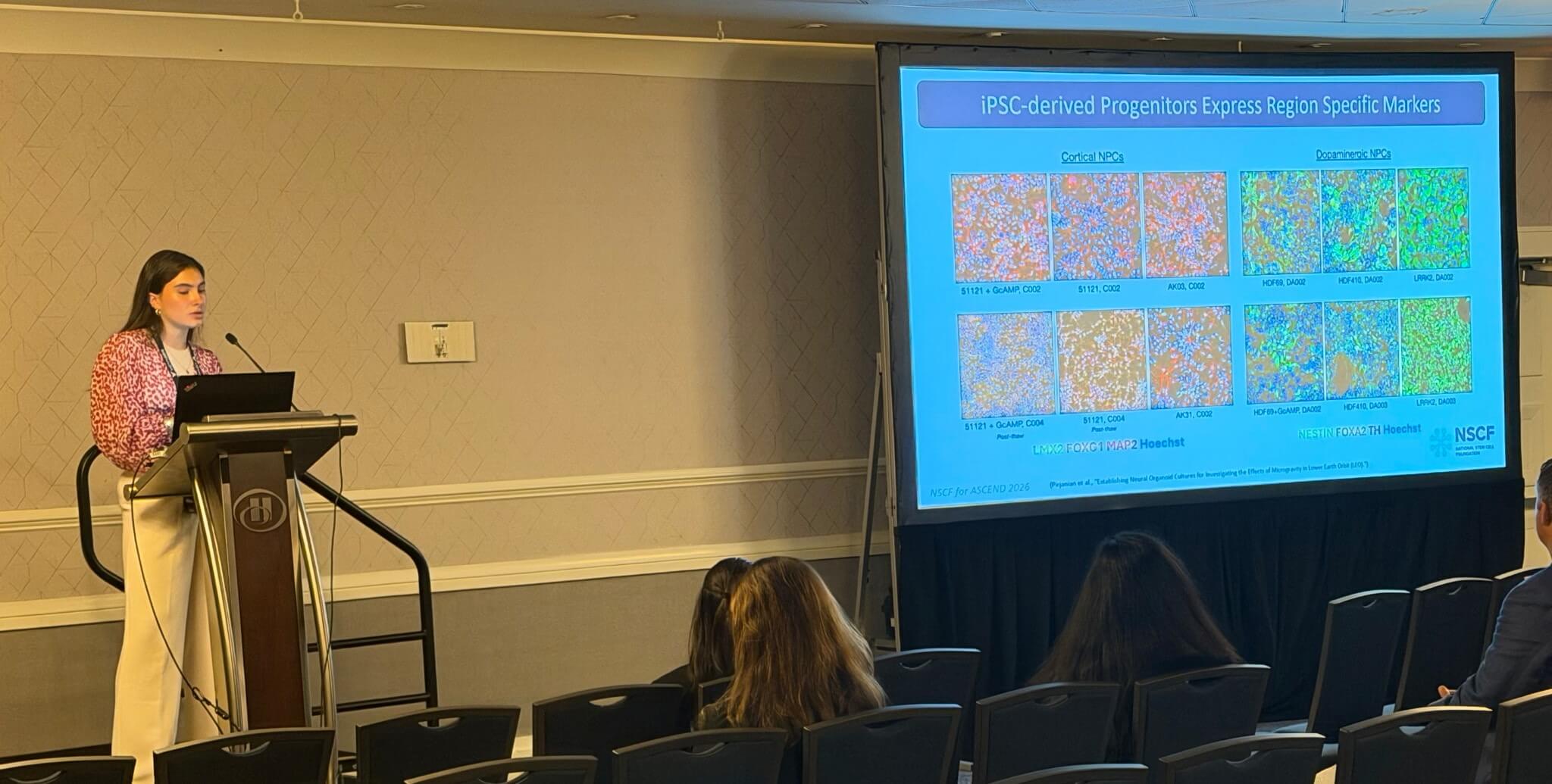
Maria presented “Organoids in Orbit: Neurodegeneration Research Aboard the International Space Station” — her first oral presentation at a major conference, and a showcase of what seven years of sustained microgravity research looks like in practice.
Maria captured what makes these sessions so valuable for researchers in this field: “Getting to hear from people in your field is really amazing when you are in the microgravity niche. It’s not as common to meet many people in biotech or academia in this field on a day-to-day basis.” For NSCF and others, ASCEND is where the broader community catches up on work and breakthroughs in the field, forms partnerships, and builds collaborations that may change the way we think about biology.
The recipient of a NASA In Space Production Applications (InSpa) award – provided to teams with significant flight experience and a clear path forward to commercialization – NSCF is leveraging past flight experience to combine multiple cell types in single organoids. This cell-line “village” concept better replicates the complex biology of neurodegeneration in a population and enables “clinical trials in a dish” for drug screening and development.
Axiom Space: Building the Evidence Base for Space Biopharma
A significant presentation came from Dr. Pinar Mesci, Global Head of Biomanufacturing and Biotechnology at Axiom Space and a key collaborator in NSCF’s brain organoid research program.
Presenting on the ISS National Lab’s technical track focused on commercial use and innovative solutions for in-space manufacturing, Pinar identified the central constraint the field has faced: “The problem is because it’s so hard to get to space, you usually get to do your experiments only once.” Axiom’s answer has been cadence — more than 200 payloads flown with over 30 countries and 50 organizations since its first private astronaut mission in 2022. With repetition comes statistical power, and with statistical power comes publishable, actionable science.
The results are compelling. Tumor organoids in microgravity develop two to three times faster than ground controls, enabling in-orbit drug challenges — one of which has already advanced to Investigational New Drug status. Immune function research on crew blood stem cells appeared in Cell Stem Cell. And brain organoid experiments conducted by NSCF showed that microgravity accelerates organoid maturation, with direct implication for modeling age-related neurological diseases and significantly increasing the pace and insight of discovery.
Pinar reinforced this point, noting, “If microgravity can help us make better models with an accelerated maturation that mimics better the adult human brain, you have a better chance of finding biomarkers or doing drug screenings for diseases where age is the main risk factor such as Alzheimer’s disease.” That is precisely the science undergirding NSCF’s next research chapter.
Major Medical Institutions Bet on Space
Perhaps the clearest signal of how far the field has come was the presence of two of the country’s most prestigious health systems at ASCEND — not as observers, but as active research participants: Cedars-Sinai Medical Center and the Cleveland Clinic. On the academic side, former NASA astronaut Kate Rubins, a world-renowned expert in molecular and cellular biology, is leading the Trivedi Institute for Space and Global Biomedicine at the University of Pittsburgh specifically to bridge the translation of space discoveries to public health. The institute, established in January, is also applying space-designed health monitoring tools to remote clinics in places like the Democratic Republic of Congo, where low-resource environments demand exactly the kind of compact, autonomous technology built for orbit.
At Cedars-Sinai, stem cell biologist Arun Sharma founded the Center for Space Medicine Research a decade ago and pioneered the first long-duration cell culture experiment in space using human stem cell-derived heart muscle cells. His team is now focused on automated biomanufacturing in orbit — building all-in-one systems capable of producing cell and gene therapies at scale or running high-throughput organoid screens to discover new therapeutic compounds.
At Cleveland Clinic — ranked the number one cardiovascular hospital in the country — Dr. Kenneth Mayuga founded the Space Health Center earlier this year, with more than 15 physician scientists already engaged. His team has already applied exercise protocols developed for astronauts to treat patients with POTS, a debilitating autonomic nervous system disorder. His center recently received an ISS National Lab STEM research grant to develop a space medicine curriculum launching next month. “Partnering with the ISS has been great,” Mayuga said. “It’s opened so many doors.”
The message across all three institutions was the same: the ISS has functioned as more than a laboratory. It has been a proof-of-concept platform that gave serious medical researchers the evidence they needed to invest.
What Comes Next
ASCEND 2026 made clear that the era of proving microgravity science is real is over. The next phase — scaling it, standardizing it, and connecting it to the patients who will ultimately benefit — is underway. NSCF, with six missions flown, three more funded, and a series of firsts in the field, is positioned to be central to that transition.
As Michael Roberts, chief scientist of the ISS National Lab, put it at ASCEND: “We have opportunities to continue to de-risk these new technology platforms that will open new gateways to discovery.”
The lab bench is in orbit. NSCF intends to be right there at the frontier of what comes next — uncovering the biological origins and early warning signs of diseases like Alzheimer’s that have eluded researchers for generations.
Paula Grisanti is found and CEO of the National Stem Cell Foundation, headquartered in Louisville, Kentucky. NSCF is a NASA InSpa award recipient currently conducting neurodegenerative disease research aboard the International Space Station.