By Maria G. Balaguer, Researcher, National Stem Cell Foundation
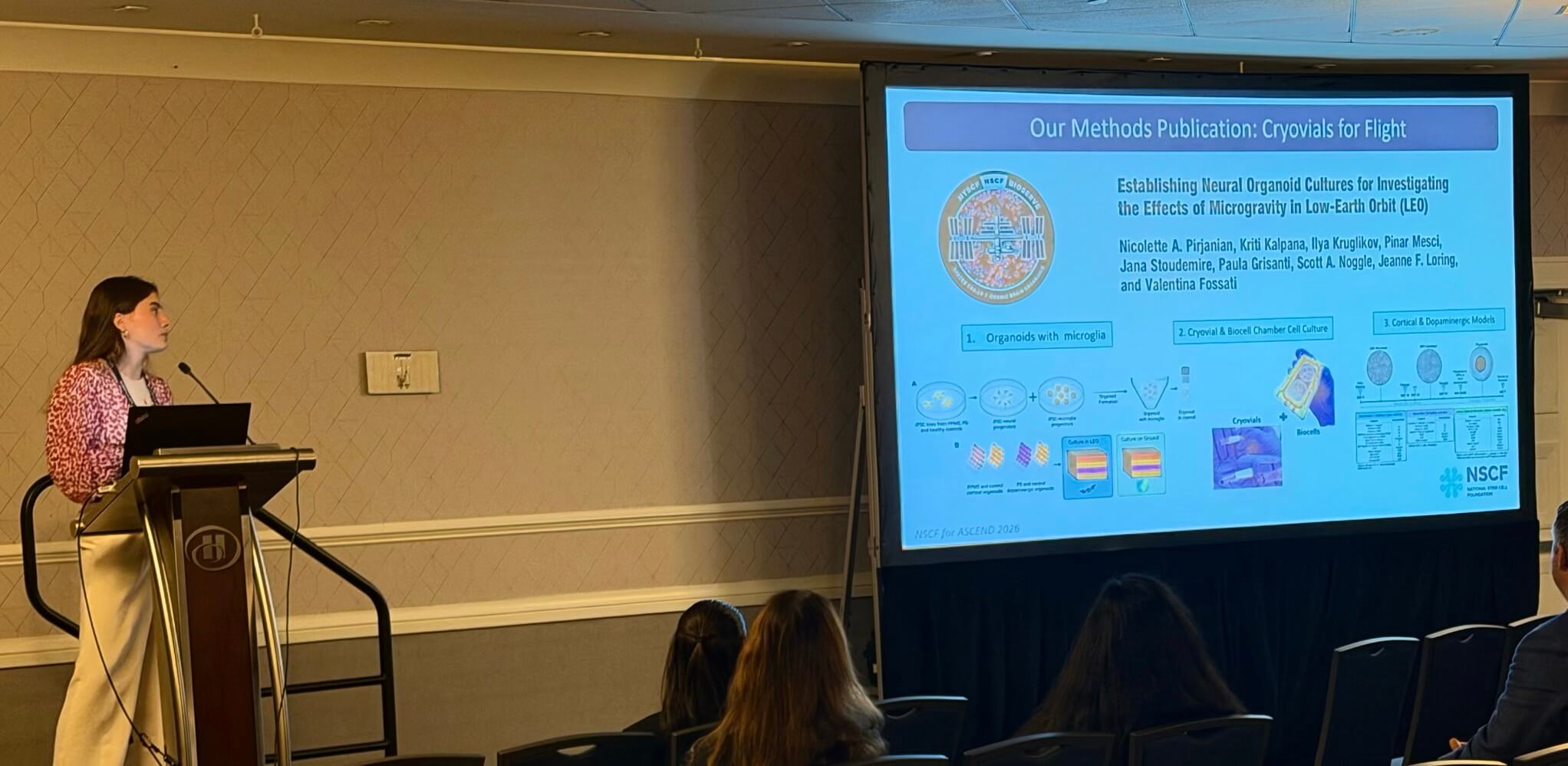
In May, I traveled to Washington, D.C., to present at the AIAA 2026 ASCEND conference. Being relatively new to the field of space research, after joining National Stem Cell Foundation (NSCF) team just over a year ago, it was a professional milestone to attend and present at a conference with exposure to such a rich community of accomplished space-driven professionals; scientists, policymakers, and astronauts all gathered around a shared conviction for the critical role of space research in humanity’s future.
The opening keynote by NASA Administrator Jared Isaacman — set a forward-thinking and visionary tone for the conference, focusing on what needs to get done to ensure the longevity of space research. That visionary spirit carried through the week, especially in the “Biology and Medicine Technical Sessions”, where I found myself surrounded by fellow microgravity researchers. Microgravity continues to be a highly specialized niche across biotech and academia; ASCEND was one of the few places where multiple industries leveraging this unique environment gather to share their work.
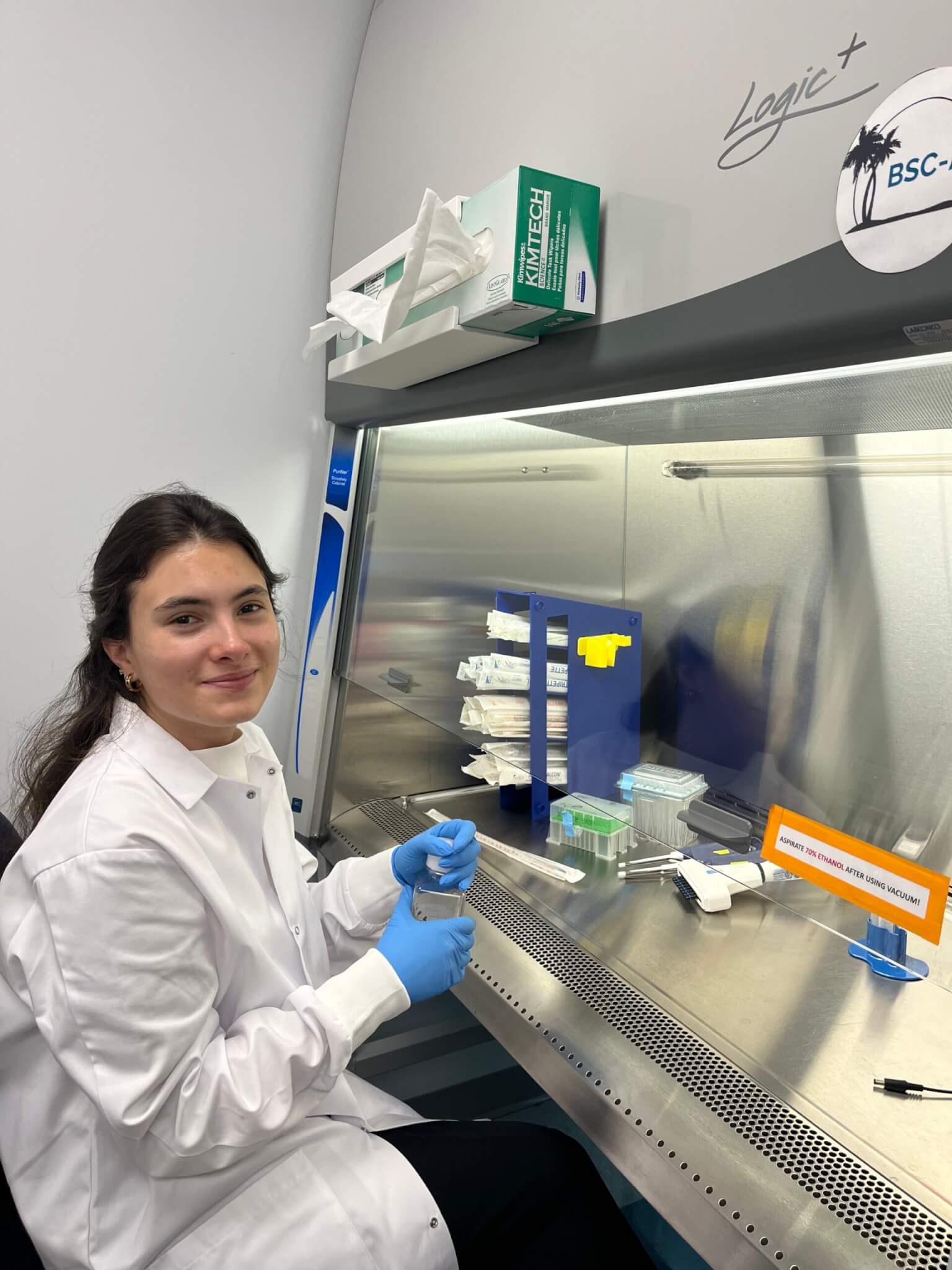
I joined NSCF in March 2025, after conducting research at UC San Diego focused on neural circuits of addiction using rodent models of substance abuse. Over the years, I have gained valuable experience and skills in a variety of disease modeling disciplines for neurological disease— stem cell–derived cell cultures, three-dimensional organoids (or “mini-organs in a dish”), and rodent models. What has remained constant throughout my career is my focus on neurodevelopmental and neurodegenerative diseases, which has led me to study Alzheimer’s, Parkinson’s, and related dementias.
While I don’t work directly treating patients, I see my research as a meaningful contribution to human healthcare, which is deeply motivating and fulfilling. Whether experiments happen on Earth or in microgravity, the goal is the same: to build better disease models that deepen our understanding of disease mechanisms and support the development of more effective therapies. Knowing that my work has the potential to create a positive impact on patients living with conditions with unmet medical needs is what drives my commitment to research.
Why Microgravity Matters for Brain Disease
At ASCEND, I presented “Organoids in Orbit: Neurodegeneration Research Aboard the International Space Station” — my first oral presentation at a major conference. The talk showcased the most notable findings from NSCF’s seven-plus years of missions to the ISS and outlined how we continue to build on that foundation.
One of our most significant discoveries is that maturation accelerates in microgravity. For diseases like Alzheimer’s, Parkinson’s, and Multiple Sclerosis — which are typically late-onset conditions that have often been progressing quietly for years before symptoms appear — this is a potentially transformative finding. Traditional Earth-based models can take a long time to “age” into something that resembles a patient’s condition. By leveraging the environment in lower Earth orbit (LEO) to accelerate maturation reliably, we aim to establish a more relevant model for late-onset neurodegenerative diseases: One which not only enhances existing models, but also serves as a screening platform for testing of potential therapies in a more time-efficient way.
Inside Our ‘Drug Challenge’ Experiments
A key part of my ASCEND presentation focused on what we call a “drug challenge” in microgravity. Using specialized culture chambers aboard the ISS, we can:
- Grow cortical and dopaminergic organoids (brain-relevant models)
- Administer a therapeutic compound while they’re in orbit
- Compare how they mature over 30 days in microgravity
Unlike sealed cryovials, these chambers allow direct manipulation of the media — meaning we can introduce drugs, change nutrients, or collect samples in ways that aren’t possible with more basic containment systems.
We’re still analyzing the latest data, but we’ve already seen that a specific metabolic enzyme alters the expression of genes involved in cell signaling, cell turnover, and maturation markers for late-stage dopaminergic and cortical neurons in our model. We don’t yet fully understand the link between metabolism, maturation, and microgravity, but the evidence suggests we can tune the rate of maturation — a capability that may prove critical for understanding how neurodegenerative diseases emerge and progress.
Building a ‘Village’ of Patients in a Single Organoid
One concept that generated real excitement — and sharp, thoughtful questions — at ASCEND was our “Village” organoid model. Traditionally, you take cells from one patient, reprogram them into stem cells, and grow a single-patient organoid. We’re developing protocols to combine cells from many different patients and grow a single brain organoid that represents a broader patient population.
Instead of sending ten organoids from ten different people to the ISS, we can send village organoids containing cells from multiple patients and potentially represent hundreds of individuals. For diseases like dementia — which are highly heterogeneous, with different people experiencing very different symptoms, trajectories, and brain changes even under the same diagnosis — this approach lets us capture that diversity in a compact, space-efficient way. It moves us meaningfully closer to “clinical trials in a dish.”
Researchers at ASCEND asked smart questions about feasibility, patient matching, and whether we can still extract patient-specific information from a mixed model. With advanced data analysis and single-cell approaches, we believe we can untangle the signals and learn from each contributing cell line.
A Global Space Community in Action
ASCEND was also my first real immersion in the broader space ecosystem. The “Biology and Medicine Technical Sessions”, sponsored by the ISS National Lab, gathered researchers working on cancer organoids, proteomics aboard the ISS, and bioreactor and hardware development for microgravity. Companies like Axiom Space and VAST shared how they’re building the infrastructure that will carry space research in the transition beyond the ISS era and into commercial stations. I even had the privilege of meeting Miguel López Alegría, commander of the Axiom Ax-1 and Ax-3 missions — a reminder of the human element at the heart of all this work.
I was especially struck by Boryung, a Korean pharmaceutical company making aggressive investments in space-based research. Pairing pharmaceutical development with space-enabled disease modeling is a natural fit when the goal is to bring better therapies to patients faster. In parallel, NSCF is deepening international collaborations — including conversations with other countries who are interested in flying their cells with us — to expand our models to more diseases, more patients, and more diverse populations. Sharing technology and expertise to elevate regenerative medicine globally is one of the most energizing parts of this work.
Looking Ahead: SpaceX-35 and Beyond
As I look beyond ASCEND, my focus is on our next mission: SpaceX-35, currently targeted for October. Launch preparation is its own discipline. Unlike a standard lab experiment, spaceflight research requires extensive verification testing, hardware compatibility checks, and iterative troubleshooting when technology underperforms. Procedures must also be designed for astronauts who are simultaneously conducting spacewalks, performing ISS maintenance, and running dozens of other experiments.
There are nights when we’re in the lab until 11 p.m., rehearsing load procedures and simulating launch timelines. But the idea of flying to Kennedy Space Center, loading our science, and watching a rocket fly our organoids to orbit is something I’ve long worked toward.
ASCEND reinforced something I had already seen: the space community is a tight-knit, deeply motivated group with enormous work ahead — and enormous promise. For me, this work is about more than just flying to space. It’s about thinking creatively and aggressively to accelerate the biological discoveries needed to help people living with devastating brain diseases and the harnessing the power of microgravity to improve human health worldwide.